The Rug Size Guide: How to Fit the Perfect Rug in Every Room
Please note: This website contains affiliate links. As an Amazon Associate, we earn from qualifying purchases at no additional cost to you.
There is a specific kind of heartbreak that happens the moment you unroll a brand-new rug, step back, and realize it looks like a postage stamp in the middle of your living room.
It’s one of those design tasks that feels entirely straightforward until you’re standing in an aisle with a tape measure, staring at standard dimensions, and completely second-guessing your math.
A rug that’s too small instantly makes a space look disjointed and cheap.
A rug that’s too big completely swallows your furniture.
But when you get the scale exactly right? The whole room instantly clicks into place. This rug size guide strips away the guesswork and breaks the rules down room by room, so you can actually buy with confidence.
The Universal Rug Rule (Before We Get Into Rooms)
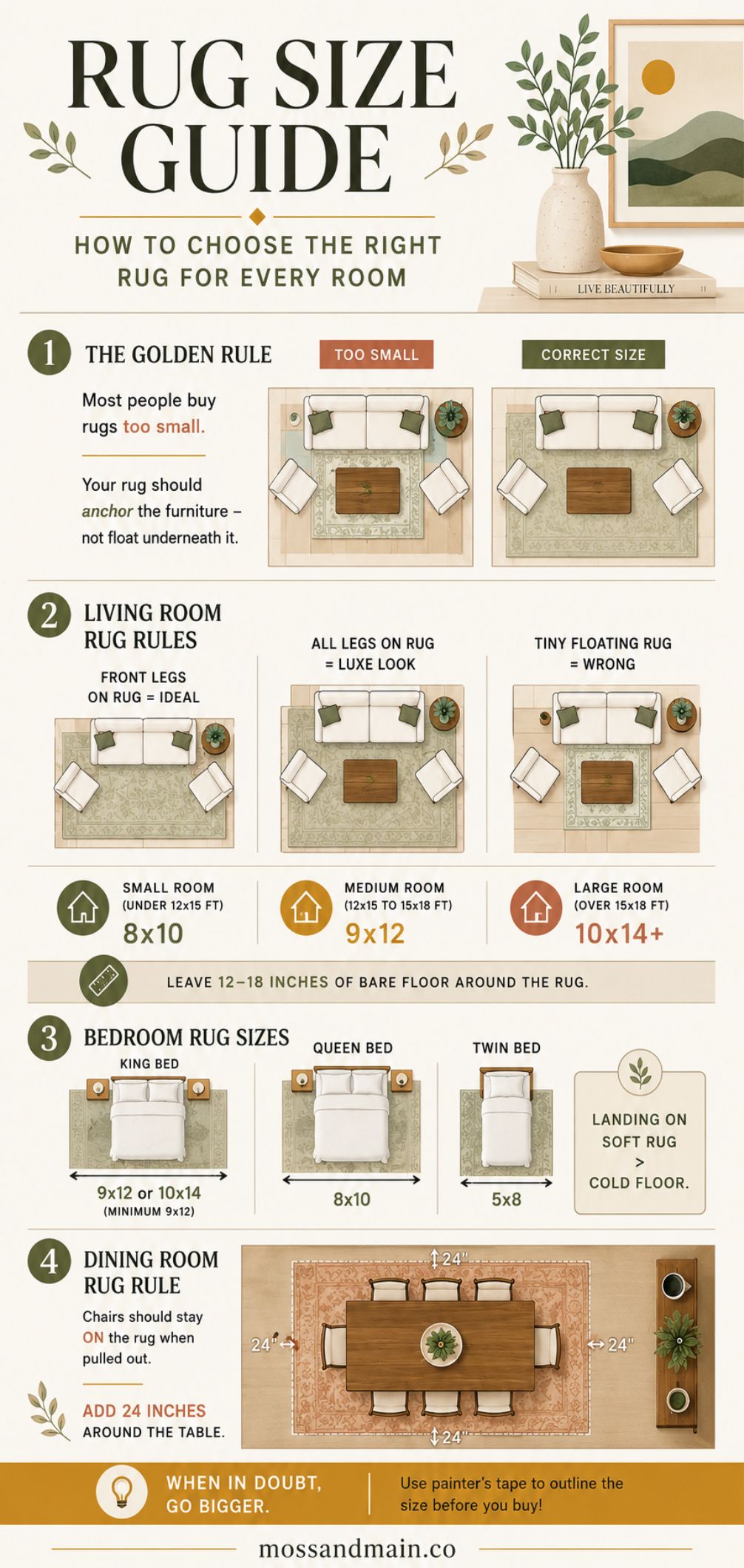
Before we dive in, there’s one rule that applies everywhere: rugs that are too small are the most common decorating mistake in any room. Almost everyone defaults to a rug that’s one size too small. When in doubt, go bigger.
The general principle is that a rug should anchor the furniture grouping — not float underneath one or two pieces while the rest of the room is on bare floor. Think of the rug as a frame. The furniture should sit in the frame, not around the edges of it.
With that in mind, let’s go room by room.
If you just need a quick summary on the best rug sizes for your home, jump to our Rug Size cheat sheet.
Living Room Rug Size Guide
The living room is where rug sizing gets the most attention — and causes the most confusion — because there are so many furniture configurations to account for.
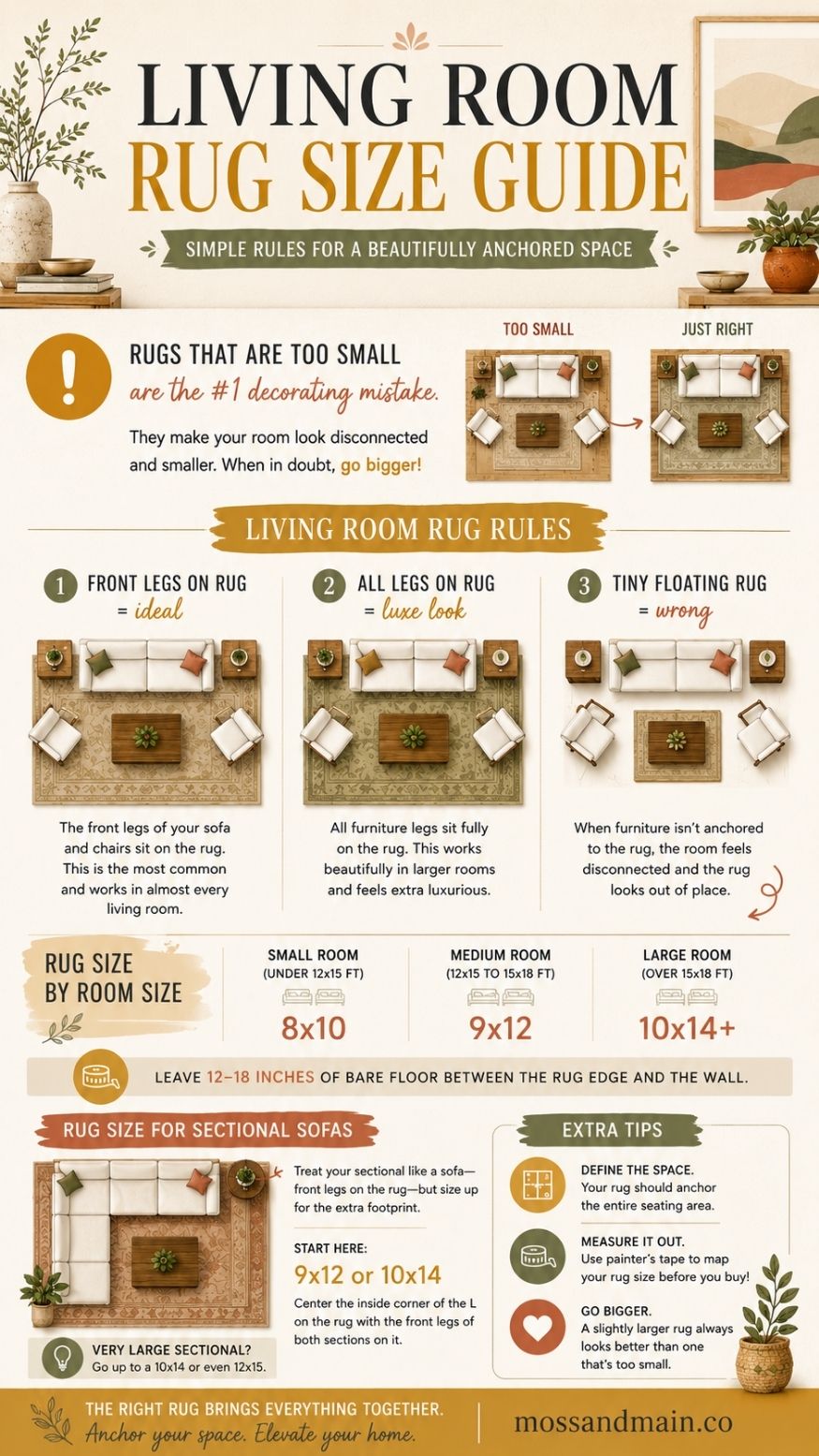
The standard rule: All front legs of the main furniture pieces (sofa, chairs) should sit on the rug. This is the most widely recommended approach and works in almost every living room layout.
The more generous rule: All four legs of every piece of furniture sit fully on the rug. This works beautifully in larger rooms and creates an especially pulled-together, luxurious look.
The minimum: At the very least, the coffee table and the front two legs of the sofa should be on the rug. If you can’t do at least this, the rug is too small.
Living Room Rug Sizes by Room Size
- Small living room (under 12×15 ft): An 8×10 rug is usually the right call
- Medium living room (12×15 to 15×18 ft): 9×12 is the sweet spot
- Large living room (over 15×18 ft): A 10×14 or larger; consider two rugs in an open-plan space
Leave 12–18 inches of bare floor between the rug edge and the wall. This border of exposed floor is what makes the room feel intentional rather than wall-to-wall carpeted.
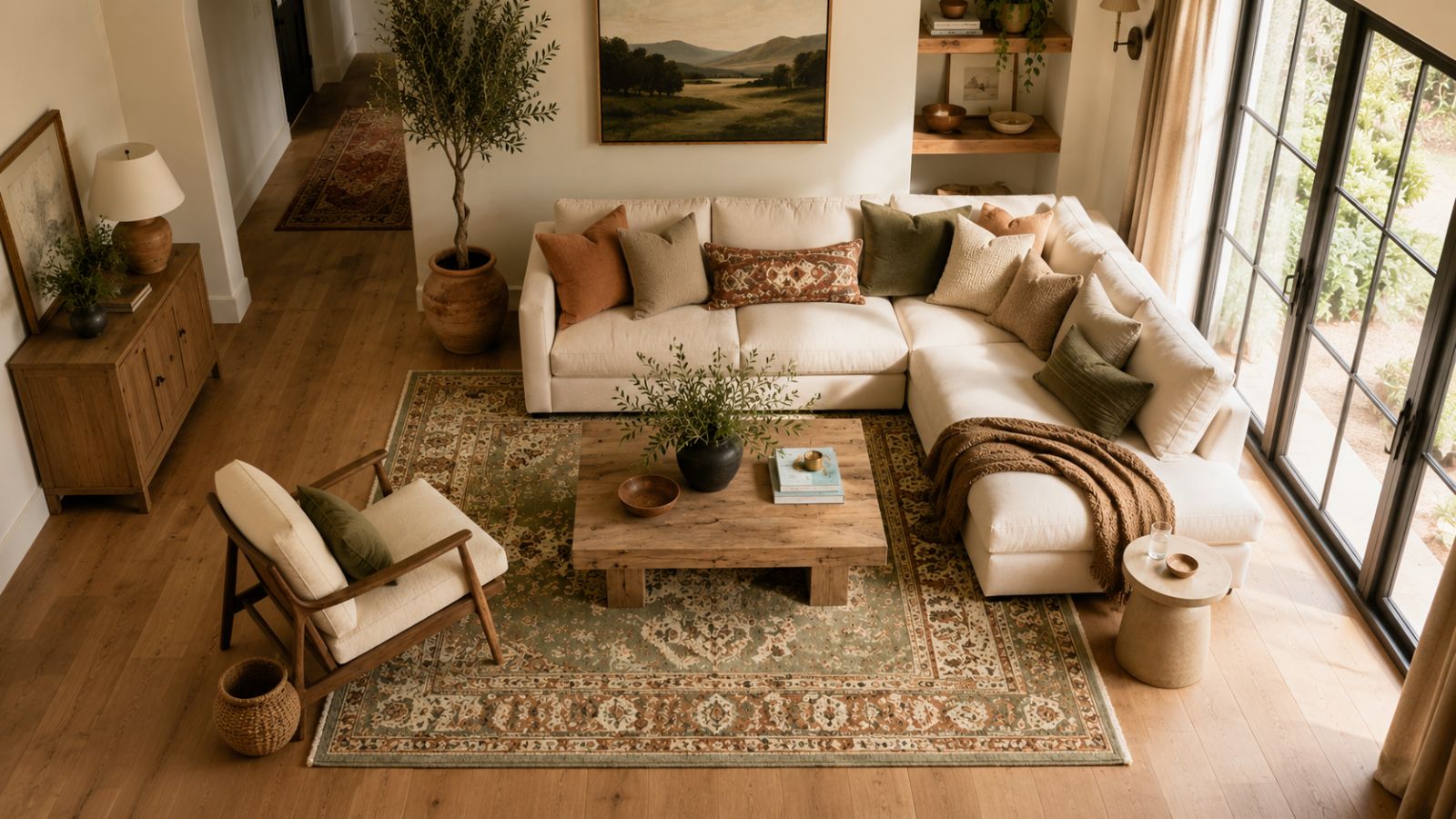
Rug Size for Sectional Couch
Sectionals throw people off because of the L-shape. The key is to treat the sectional the same way you’d treat a regular sofa — front legs on, back legs off — but size up to account for the extra footprint.
For most sectionals, a 9×12 or 10×14 rug is the right starting point. Position the rug so the inside corner of the L sits roughly centered on the rug, with the front legs of both sections landing on it. If your sectional is very large, go up to a 10×14 or even 12×15.
Bedroom Rug Size Guide
Bedroom rugs are all about what you feel when you step out of bed in the morning. The goal is to land on rug, not cold floor — and to frame the bed in a way that feels intentional and cozy.
Rug Size for a King Bed
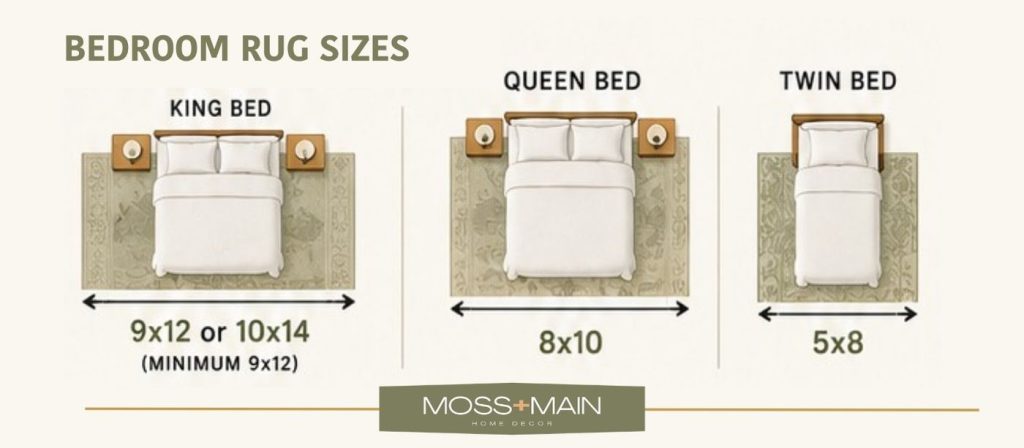
A king bed needs a generous rug to look right. The most common mistake is going with an 8×10, which ends up looking like a postage stamp under such a large piece of furniture.
Best options for a king bed:
- 9×12 — the minimum for a king; works if the room isn’t too large
- 10×14 — the ideal size; gives you 2–3 feet of rug on each side and at the foot of the bed
- 8×10 — only works if you position it at the foot of the bed rather than underneath it (more on placement below)
Rug Size for a Queen Bed
Queen beds are the most forgiving to work with. An 8×10 is usually perfect — it gives you 18–24 inches of rug on each side and at the foot. In a smaller room, a 5×8 placed at the foot of the bed can also work well.
Rug Size for a Twin Bed
For a twin, a 5×8 or 6×9 placed alongside the bed works well. If the bed is against the wall, you only need rug on one side and the foot, so a 4×6 or 5×8 is usually sufficient.
Bedroom Rug Placement Options
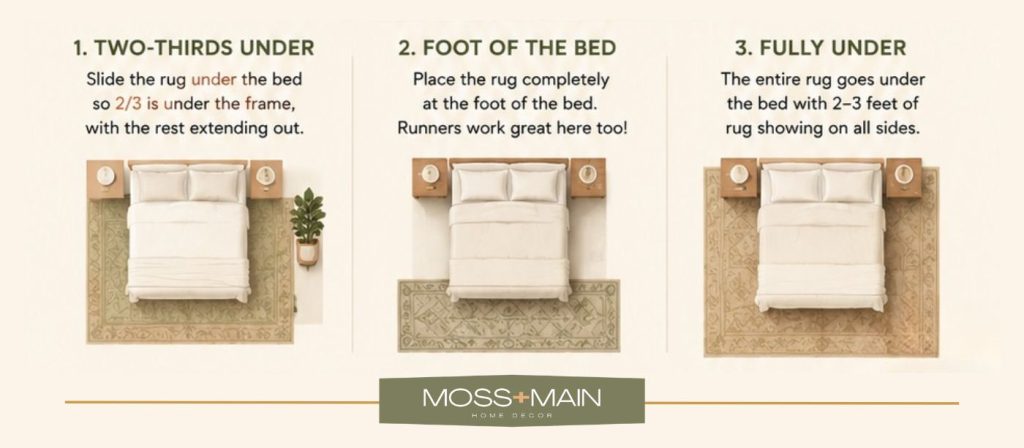
There are three main ways to position a rug in a bedroom:
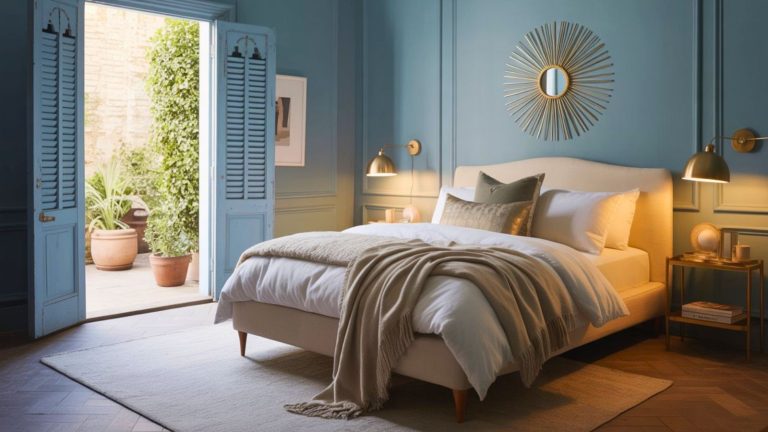
Option 1: Two-thirds under the bed. Slide the rug under the bed so roughly two-thirds of the rug is under the frame, with the remaining third extending out at the foot. This is the classic approach.
PRO TIP: It’s a little hard to see in the image above, but if you are going with this option, there should be a gap of about 2 to 4 inches in between your nightstand and where the rug begins.
Option 2: Foot of the bed only. Place the rug entirely at the foot of the bed, not under it. Works well with a smaller rug and in rooms where you want to show off a beautiful floor. A runner works well here too.
Option 3: Full under the bed. The entire rug goes under the bed, with 2–3 feet extending out on each side and at the foot. This requires a larger rug but creates the most luxurious, hotel-like effect.
Dining Room Rug Size Guide
Dining room rugs have one non-negotiable rule: the rug must be large enough that the chairs stay on the rug even when pulled out. If a chair slides off the rug every time someone sits down or stands up, the rug is too small — full stop.
The standard recommendation is to add 24 inches to each side of your dining table to get your minimum rug size. So if your dining table is 36×72 inches, you need a rug that’s at least 84×120 inches (7×10 feet).
Dining Room Rug Sizes by Table Size
- Small round or square table (up to 48″): 6×9 or 8-foot round
- Medium rectangular table (60–72″): 8×10
- Large rectangular table (84–96″): 9×12
- Extra large or extending table: 10×14
Shape Matters in the Dining Room
Round tables look especially good with round rugs — the shapes echo each other and the room feels more cohesive. Rectangular tables work with either rectangular or round rugs, though rectangular is more common and usually easier to size correctly.
Kitchen Rug Size Guide
Kitchen rugs are more functional than decorative, and sizing is usually dictated by the layout rather than furniture.
- In front of the sink: A runner (2×6 or 2×8) is the standard and most practical choice
- In front of an island: A runner sized to match the length of the island — usually 2×8 or 3×10
- Open kitchen/dining area: Treat this like a dining room and size accordingly
The main thing to avoid in a kitchen is a rug that’s too wide for the walkway, which becomes a tripping hazard and makes the space feel cramped.
Entryway and Hallway Rug Size Guide
Entryways and hallways are runner territory. The goal is to lead the eye and protect the floor, not to fill the entire space.
- Small entryway: A 2×3 or 3×5 works — just enough to wipe feet and add a moment of warmth
- Larger foyer: A 4×6 or even 5×8 can work if the space is square or rectangular and has room to breathe
- Hallway: A runner sized to leave 4–6 inches of bare floor on each side — usually 2×8 or 2×10 depending on hall length
Home Office Rug Size Guide
Home office rugs are often an afterthought, but they make a real difference in how pulled-together the space feels — and how comfortable it is to work in.
Under the desk: A 5×8 or 6×9 centered under the desk, with the desk chair able to roll on the rug comfortably. Make sure the rug extends in front of the desk so you’re not rolling back and forth between rug and bare floor constantly — that gets annoying fast.
Full seating area: If your office has a chair or small sofa for reading, treat that grouping like a mini living room and size accordingly.
Quick-Reference Rug Size Cheat Sheet
Save this for your next shopping trip:
| Room | Furniture | Recommended Rug Size |
|---|---|---|
| Living room (small) | Standard sofa | 8×10 |
| Living room (medium) | Standard sofa | 9×12 |
| Living room (large) | Sectional | 10×14 |
| Bedroom | King bed | 9×12 or 10×14 |
| Bedroom | Queen bed | 8×10 |
| Bedroom | Twin bed | 5×8 |
| Dining room | Small table (up to 48″) | 6×9 |
| Dining room | Medium table (60–72″) | 8×10 |
| Dining room | Large table (84–96″) | 9×12 |
| Kitchen | In front of sink/island | 2×6 or 2×8 runner |
| Entryway | Small | 3×5 |
| Hallway | Standard | 2×8 runner |
| Home office | Under desk | 5×8 or 6×9 |
SAVE THIS FOR LATER!
Frequently Asked Questions
What is the most common rug size mistake?
Going too small. Almost universally, people choose a rug that’s one size too small for the space — usually because it looks fine in the store or online, but once it’s in the room under actual furniture it disappears. When you’re between two sizes, go bigger.
Should all furniture legs be on the rug?
Not necessarily — and this is a common misconception. The most popular approach is front legs on, back legs off. This is especially true for sofas and chairs in a living room. All legs on works too, but requires a larger (and more expensive) rug. The one thing that doesn’t work is no legs on the rug at all — that’s when the rug looks like it wandered into the room by accident.
What size rug do I need for a king bed?
For a king bed, a 9×12 is the minimum, and a 10×14 is ideal. The rug should extend at least 18–24 inches beyond each side of the bed and at the foot so you land on rug when you step out of bed.
Can a rug be too big?
Yes, but it’s much less common than going too small. A rug is too big when it leaves less than 12 inches of bare floor between the rug edge and the wall — at that point it starts to look like wall-to-wall carpet. In a very small room, a rug that’s too large can also make the space feel more cramped rather than larger.
What shape rug should I choose?
Follow the shape of the room or the furniture grouping. Rectangular rooms and rectangular furniture groupings get rectangular rugs. Round tables look great with round rugs. An organic or irregular room shape can handle a more interesting rug shape. Runners work in narrow spaces like hallways and in front of kitchen islands.
How do I know if my rug is the right size before I buy?
Use painter’s tape on the floor to outline the rug dimensions before you buy. It takes five minutes and saves a ton of headache. Stand back and look at it from the doorway — that’s the most honest view of whether the size is going to work.
Does rug size affect how big a room feels?
Yes, significantly. A rug that’s properly sized — especially one that’s slightly larger than people typically choose — makes a room feel larger, more intentional, and more cohesive. A rug that’s too small makes the room feel chopped up and smaller. The right rug size is genuinely one of the most impactful (and underrated) things you can do for a room.
The Bottom Line
The right rug size isn’t about following a rigid formula — it’s about understanding what the rug is doing in the space and sizing it accordingly. It should anchor the furniture, define the zone, and give people somewhere soft to land.
When in doubt: go bigger, leave a border of bare floor around the edges, and use painter’s tape before you commit to a purchase. Those three habits will save you from the most common rug mistakes — and keep you from having to return a 9×12 rolled-up rug, which is nobody’s idea of a good afternoon.
Looking for more room-by-room decorating guides? Browse the Moss & Main archives for tips on every space in your home.
Please note: This website contains affiliate links. As an Amazon Associate, we earn from qualifying purchases at no additional cost to you.